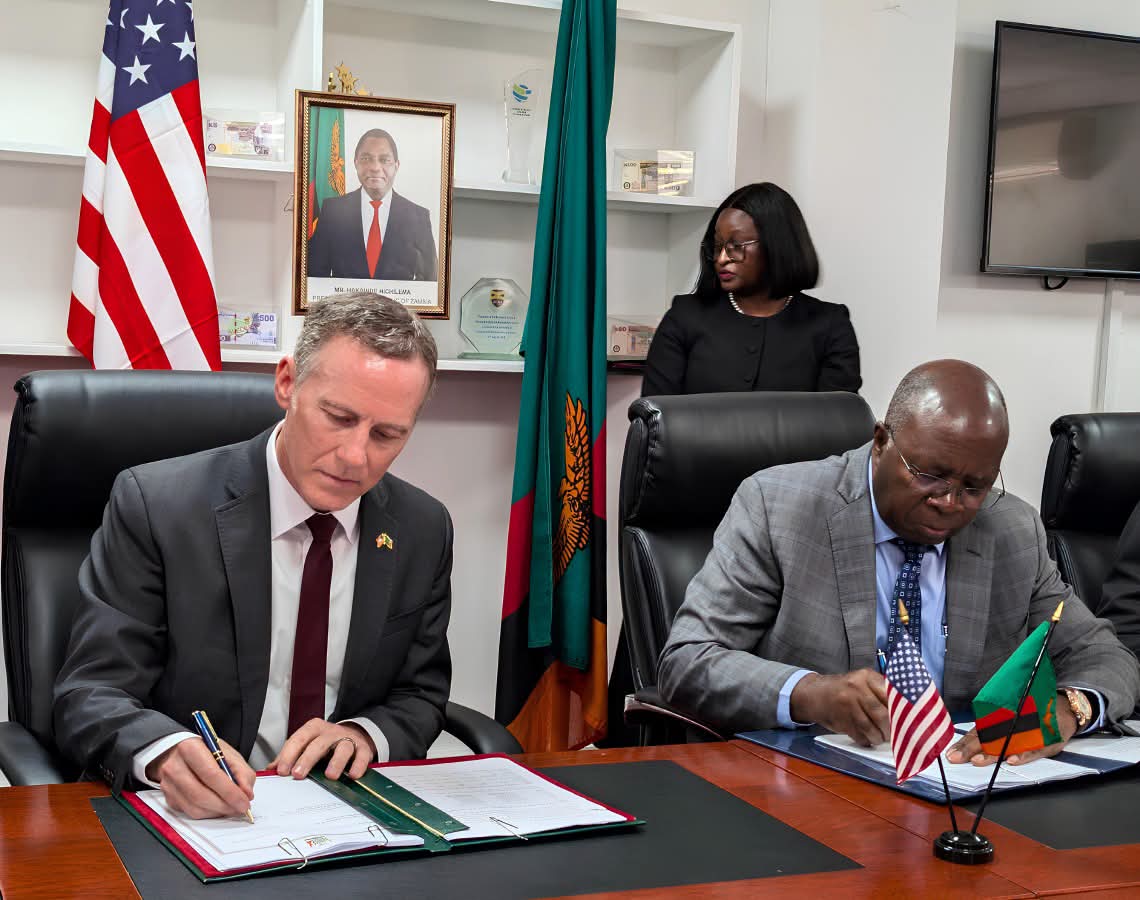
Zambia Signs $2.49 Billion US Health Deal After Months of Disputes Over Data and Minerals
Zambia has signed a five year health financing agreement with the United States after months of disagreement over proposed conditions involving medical data, biological samples and allegations linking health assistance to access to the country's mineral wealth.
The agreement, signed in Lusaka on Thursday, October 8, 2026, commits the United States to providing more than $1.5 billion towards priority health programmes, subject to working with Congress. Zambia has pledged to increase its own domestic health expenditure by $975 million over the same period.
Together, the commitments outlined in the memorandum of understanding amount to $2.49 billion.
But the signing comes after an earlier draft of the agreement triggered objections from civil society groups, health advocates and political figures, turning what was supposed to be a health financing arrangement into a wider debate about privacy, national interests and the conditions attached to foreign assistance.
What changed after the earlier objections?
One of the biggest concerns surrounding the proposed agreement was how Zambia's medical information and biological samples could be shared with the United States.
Civil society organisations warned that the earlier draft could give the US broad access to sensitive health information. The Chapter One Foundation raised concerns about the protection of citizens' medical data, while HIV advocacy groups, including the Treatment Advocacy and Literacy Campaign, questioned whether the arrangement offered sufficient safeguards.
The government also raised objections.
In May, Foreign Affairs Minister Mulambo Haimbe criticised the proposed data-sharing terms, describing them as a violation of privacy and calling them unconscionable.
There were also allegations that the health financing package was linked to preferential access for American companies to Zambia's copper and other critical minerals. The then US ambassador, Michael Gonzales, rejected that account.
Those disagreements placed the proposed agreement under scrutiny before the two countries eventually signed the revised arrangement.
Government says patient records will be protected
Health Minister Professor Roma Chilengi has said the revised agreement addresses key concerns surrounding the sharing of medical information.
According to the minister, provisions requiring Zambia to send biological specimens to the United States were removed. He also said the agreement would not permit the sharing of individual patient records.
Instead, data exchange would be limited to information needed to monitor and evaluate programmes supported through the agreement.
These changes address some of the concerns raised during the earlier negotiations. However, the precise scope of data exchange and how the safeguards will operate in practice remain important issues as the agreement is implemented.
A separate data-sharing agreement was also signed alongside the health financing memorandum.
How the $2.49 billion will be used
Under the agreement, US funding is intended to support several priority areas within Zambia's healthcare system.
These include HIV/AIDS, tuberculosis, malaria, maternal and child health, disease surveillance, and preparedness and response to infectious disease outbreaks.
The funding will also support health system development, including work involving community health workers, laboratory services and health information systems.
The United States says the agreement builds on more than two decades of health cooperation between the two countries. The US Embassy has stated that American investments helped save nearly 1.3 million Zambian lives through HIV treatment services over the past 25 years.
However, the new arrangement also introduces a significant financial commitment for Zambia.
The government has pledged to increase domestic health spending by $975 million over five years, gradually assuming greater responsibility as US funding declines.
Why the agreement matters beyond the money
The deal reflects a change in how Washington intends to finance health programmes in partner countries.
Following the closure of the US Agency for International Development, or USAID, in 2025, the Trump administration has pursued bilateral health agreements that place greater emphasis on partner governments contributing more of their own resources.
Several African countries have signed similar agreements, while others, including Ghana and Zimbabwe, have rejected proposed arrangements over concerns about conditions involving data and biological specimens.
For Zambia, the immediate question is no longer simply whether the agreement will be signed. It is how the commitments will be implemented, whether essential health services will remain adequately funded, and whether the protections announced by officials will address the concerns raised during negotiations.
The signing marks a new stage in Zambia's health partnership with the United States, following months of disagreement over the terms.
The two governments have now committed to a five year framework. Its impact will depend on how the funding, data-sharing provisions and transfer of responsibilities work in practice.
Source: US Embassy in Zambia and BBC reporting.